

Monitoring & Logs
Each GameFabric installation comes with its own dedicated monitoring solution. This setup includes a personal Grafana installation. This Grafana instance provides visibility into the systems performance and operations. The Grafana dashboard allows you to monitor all metrics generated by the platform and related services and provides access to all your game server logs from one central location.
Data availability
Logs and metrics may be delayed by up to 2 minutes due to collection and processing pipelines.
To access it, click on "Monitoring". 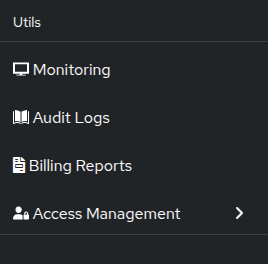
Using Monitoring
The monitoring dashboards are especially useful for:
- Tracking CCU (Concurrent Users)
- Optimizing resource requests based on actual usage
- Viewing game server logs for debugging
Permissions
To access monitoring, a user must belong to a group with a role that has at least GET permission for the monitoring resource.
Users with POST permission can create custom dashboards and alerts.
Access Control
For more information on managing permissions, see Editing Permissions.
Metrics
GameFabric comes with a Grafana instance (accessible via the "Monitoring" menu item in the sidebar of your GameFabric instance) and several preinstalled dashboards. These dashboards help you understand the performance, capacity, and reliability of your game server fleets, nodes, and sites without requiring a custom observability setup for your game servers.
Some examples of data available in Grafana:
- Game server scaling activity, including scale-up and scale-down trends
- Game server CPU and memory utilization, including percentiles, averages, regional rollups, and top consumers for anomaly detection
- Node-level host metrics for both bare metal and cloud environments
- Node connectivity checks to common external providers and endpoints
- Cluster utilization and the gap between requested resources and actual usage
- Allocator activity and request patterns
- Kubernetes events that affect your workloads
For practical guidance on sizing CPU and memory requests and limits using these metrics, see Resource management.
Game server metrics
You can expose your own Prometheus-style metrics from your game servers through metric ports. GameFabric scrapes them automatically. See Game server metrics.
Logs
Everything that the game server prints to either stdout or stderr is automatically collected and available in the monitoring dashboards.
Logs written to files inside the container are not collected automatically. File-based logs are lost when the container stops. This is relevant for game engines such as Unreal Engine that write logs to disk by default rather than to stdout.
Forwarding file-based logs
If your game server writes logs to files, you can use the Game Server Wrapper's log tailing feature to forward them to stdout. This makes file-based logs available in Grafana and the Vessel UI alongside your other logs.
Logging quotas
Logging quotas apply. If your game server exceeds the rate limits, log lines are dropped. If you require different limits, contact GameFabric support.
External integration
If you want to query your metrics and logs from your own observability tools, see the Observability tap.